Release time: September 20, 2026
Views: 52
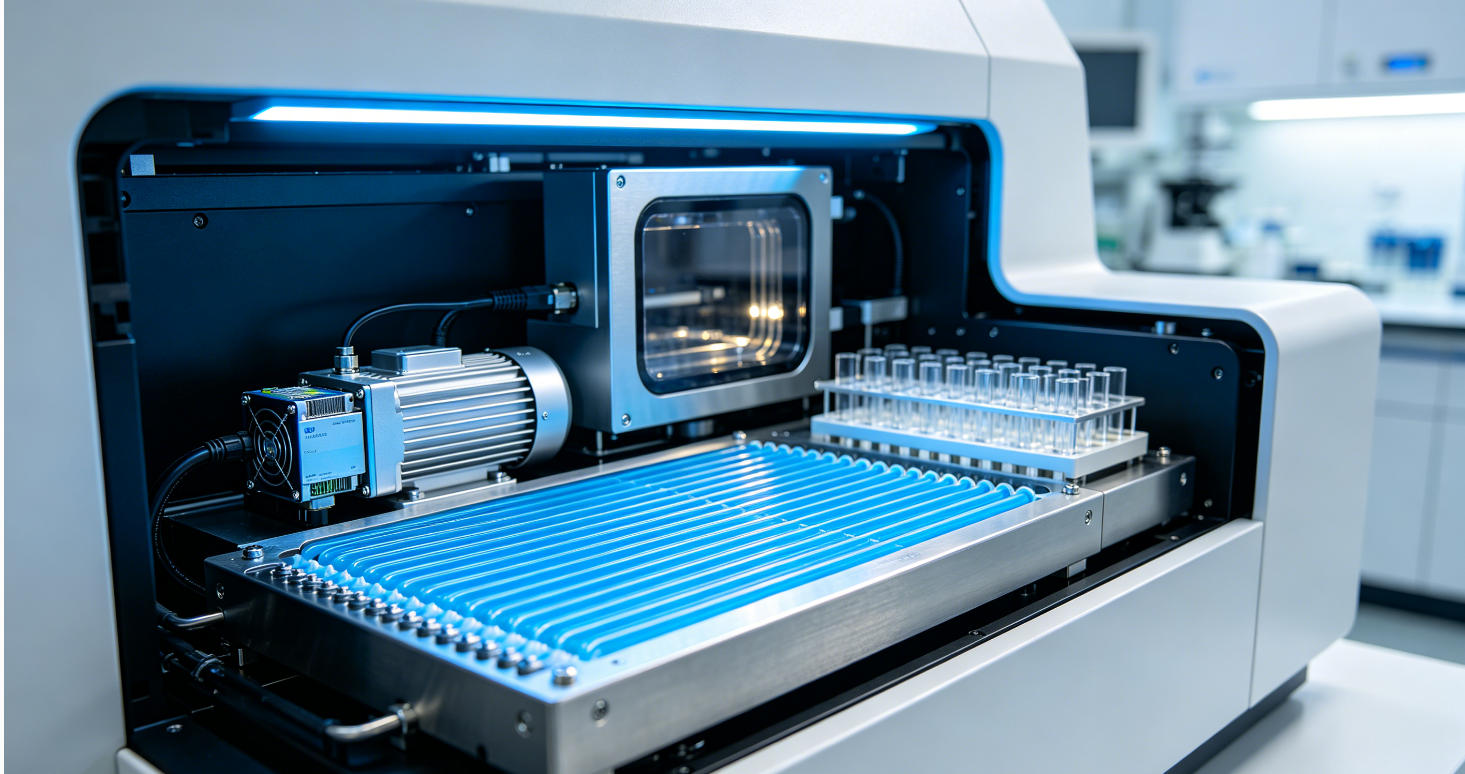
We frequently receive inquiries from clients developing IVD chemiluminescence instruments who submit heat consumption data to ask whether a compressor or semiconductor solution is suitable for their equipment. We address this type of question dozens of times every year, and it all boils down to one core issue: the scientific basis for selecting IVD water-cooled temperature control solutions. Although online comparison charts for IVD water-cooled temperature control systems list neat parameters, selections based solely on such charts often lead to on-site operational issues. This article elaborates on foolproof selection principles for reference.
Two Solutions for the Same Core Function with Distinct Working Principles
Semiconductor refrigeration relies on the Peltier effect: when direct current passes through thermocouple pairs composed of P-type and N-type semiconductors, one end absorbs heat while the other releases it. The heat absorbed by the cold side is carried away by the water-cooled plate on the hot side, and the circulating fluid is then transported outside the equipment chassis. Its prominent advantages include ultra-fast response – a temperature difference forms within seconds of power-on, cooling capacity can be adjusted precisely by modulating current, and reverse power supply enables switching to heating mode.
Vapor-compression refrigeration follows the working principle of refrigerators and air conditioners, relying on refrigerant phase change for heat transfer through four core components: compressor, condenser, throttle valve, and evaporator. Even among water-cooled chillers adopting vapor-compression technology, fixed-frequency and variable-frequency models deliver significantly different temperature control performance.
In terms of energy efficiency, the Coefficient of Performance (COP) of semiconductor refrigeration ranges from 0.3 to 0.7, while that of vapor-compression cycles reaches 2 to 4. This gap is determined by inherent working principles. Therefore, it is unfair to simply dismiss semiconductor refrigeration as uneconomical in terms of power consumption, as it compensates for higher energy consumption with superior temperature control accuracy, compact size, and rapid response speed.
1. Calculation of Equipment Heat Load
In IVD water-cooled temperature control projects, inaccurate heat load calculation is the most common cause of operational failures. Most clients only report the heat generation of individual components, such as 50W for light sources or 30W for chips, while ignoring the actual total heat load. The real heat load consists of four parts: steady-state heat generation, transient thermal shock (caused by pre-cooling at startup, reagent chamber door opening, and full-load sample placement), ambient heat leakage, and self-heating of water pumps. Small fluorescence detectors easily generate a heat load of 100-200W, while chemiluminescence and biochemical analyzers commonly reach 300-500W with combined heat generation from incubation positions and optical units.
A universal water circuit calculation formula for IVD water-cooled temperature control systems is:  . Many solution failures stem from a critical problem: sufficient cold source cooling capacity but insufficient water circuit heat transfer efficiency, resulting in overheating of controlled objects. A safety margin of no less than 30% is recommended. Notably, the cooling capacity of semiconductor refrigeration modules declines significantly at ambient temperatures above 40°C, and poor ventilation will further degrade their performance.
2. Temperature Control Accuracy and Response Speed
Equipped with optimized drivers and algorithms, semiconductor refrigeration achieves a temperature control accuracy of ±0.1°C. Its cooling capacity is regulated via PWM or linear adjustment, enabling a second-level response speed. It is the optimal, and almost exclusive, choice for scenarios requiring frequent temperature changes, such as PCR thermal cycling and stepwise temperature control for enzyme reactions.
Compressor refrigeration features high thermal inertia. Fixed-frequency compressors control temperature through start-stop cycles, resulting in a common temperature fluctuation of ±1°C. Variable-frequency compressors paired with electronic expansion valves can improve accuracy to approximately ±0.3°C, but require gradual parameter debugging.
A composite solution is required for scenarios demanding both high cooling capacity and high precision, typical of fully automatic biochemical analyzers. These devices have high heat generation from optical units while requiring ultra-stable temperatures in incubation positions. The composite system uses a compressor as the base load to adjust the circulating fluid close to the target temperature, with a series-connected semiconductor refrigeration module on the water circuit for fine temperature calibration – the compressor handles slow, large-range temperature regulation, and the semiconductor module delivers fast, precise trimming.
Sensor placement is another key factor affecting detection accuracy. Measuring temperatures at the water outlet, water return port, or on the surface of controlled objects yields completely different results. Given the large hysteresis of IVD water-cooled temperature control loops, integral saturation in PID tuning and valve dead zones must be pre-emptively optimized.
3. Space Occupancy, Vibration, Noise and Subsequent Maintenance
Space Layout: Semiconductor refrigeration modules support split design, with cold plates, water pumps and heat sinks separately embedded in equipment cavities without occupying additional external space. In contrast, compressor refrigeration systems are mostly integrated cabinet units that require external installation, so reserved space beside the equipment cabinet must be confirmed during solution evaluation.
Vibration and Noise: Chemiluminescence and fluorescence detection equipment are highly sensitive to vibration. Semiconductor refrigeration modules have no moving parts, and micro-vibrations from fans exert negligible impact on optical path stability. However, low-frequency vibration generated during compressor start-stop operations transmits to the equipment body through water pipes and bases, directly affecting optical path accuracy.
Environmental Adaptability and Maintenance: Semiconductor refrigeration water circuits cannot use antifreeze liquid, requiring complete water drainage before winter transportation or storage. Its operating environment is limited to air-conditioned laboratories with temperatures between 5°C and 40°C. Compressor systems support ethylene glycol aqueous solutions and operate stably in temperatures ranging from -20°C to 50°C, adapting to harsher environments.
In terms of maintenance, semiconductor systems only require regular dust cleaning and water replacement. Compressor systems demand more complex maintenance, with refrigerant pressure and tightness inspection required every 2 to 4 years.
Key Technical Details & Common Pitfalls
Condensation Prevention: Condensation occurs when the circulating fluid temperature is lower than the ambient dew point, causing water droplets on pipes, cold plates and cuvettes. Fogged optical windows will lead to drifted detection values. Effective condensation prevention relies on dew point calculation, thermal insulation layer laying and condensate diversion, rather than simple adhesive tape wrapping.
Circulating Fluid and Pipeline Matching: Tap water is prone to algae growth, scaling and pitting corrosion after long-term use, so deionized water is the standard circulating fluid. Pipeline materials and pump flow components must be compatible with the fluid medium. Excessively high pump flow will increase pump self-heating and noise despite slight return water temperature rise reduction; bypass design or variable-frequency pumps are more practical for most scenarios.
Semiconductor Module Selection Pitfall: Relying solely on the maximum nominal cooling capacity (Qmax) for selection is a typical mistake. Cooling capacity attenuates with rising hot-side temperature and temperature difference. When the temperature difference reaches 30-40°C, the actual available cooling capacity drops to only 30%-40% of the nominal value. The hot-side temperature must be controlled below 80°C to avoid accelerated solder layer aging and shortened service life.
Targeted Selection Recommendations
Semiconductor Refrigeration Solution: Suitable for scenarios with cooling capacity within 200W, high temperature control accuracy requirements, compact equipment size requirements, well-ventilated laboratory environments, and strict anti-vibration demands.
Compressor Refrigeration Solution: Ideal for equipment with cooling capacity exceeding 500W, systems requiring long-term stable low-temperature operation (e.g., 2-8°C large-capacity reagent cabins), and equipment used in vehicles, shipborne platforms or non-air-conditioned clinical laboratories.
200-500W Cooling Capacity Range (Difficult Selection Interval): Confirm three core questions with clients to finalize the solution: whether frequent temperature switching is required, the allowable vibration transmission to the equipment body, and the remaining internal installation space of the equipment.
Critical Reminder: Do not make selection decisions based solely on nominal power. Require suppliers to conduct thermal simulation or prototype testing under actual working conditions to confirm the final model.
In summary, the selection between semiconductor and vapor-compression refrigeration for IVD water-cooled temperature control systems cannot rely on single indicators. The stable and reliable implementation of the solution depends on systematic support including 3D structural design, CAE thermal simulation, and electronic software and hardware matching.
 Contact Our Thermal Experts:
📞 +86 18575222950 (WeChat/WhatApps)
📧 EMAIL: sale02@hj-tc.com
🌐 Browse products: https://www.huajingtc.com (Huajing Cooling Solutions)
Optimize your UAV & Laser & Beauty system's performance with Huajing's advanced thermoelectric cooling technology.


Looking for more
information?

0755 23405284
Email: sale02@hj-tc.com
Add: 3/F No.5 Building,Yesun Pingshan Life and Health Technology Park, No. 19 Linhui Road,Pingshan District, Shenzhen, Guangdong,CN.
©2019- 2024 Huajing Co.,Ltd.Copyright