Release time: July 21, 2026
Views: 359
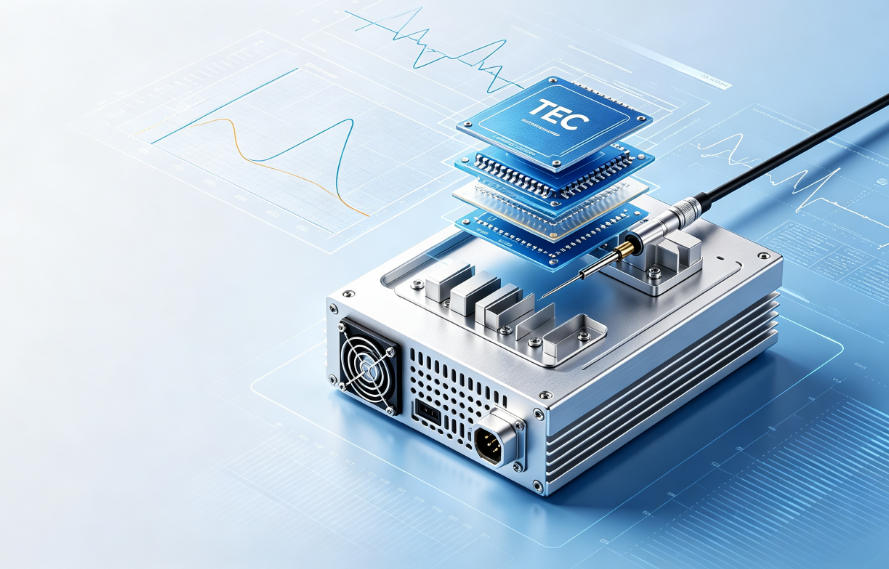
Requiring no liquid nitrogen or heating rods, the instrument adopts miniature semiconductor refrigeration chips, enabling experimental samples to achieve rapid hot and cold switching within a wide temperature range of -50℃ to +80℃, with a temperature control accuracy as high as 0.01℃.
The core principle of semiconductor refrigeration is the thermoelectric effect, which realizes high-precision bidirectional non-hysteresis temperature control through the microscopic heat transfer of electrons. A semiconductor refrigeration chip consists of dozens of thermocouple pairs sandwiched between ceramic plates. When energized, it forms a cold side and a hot side, providing physical support for the bidirectional temperature control of the equipment.
TEC (Thermoelectric Cooler) boasts remarkable advantages over traditional temperature control technologies. Compressor refrigeration is unidirectional and requires an external electric heating wire for heating, resulting in mechanical hysteresis during temperature switching. In contrast, TEC enables instantaneous switching between cold and hot sides simply by reversing the current, with no mechanical delay or inertial waiting.
Full Temperature Range Coverage Realized by Multi-stage Cascade and Bidirectional Drive
The ultra-wide temperature regulation range of -50℃ to +80℃ is mainly achieved through multi-stage cascade connection of semiconductor refrigeration chips and bidirectional current drive technology, which effectively breaks the temperature control limitations of single-stage TECs.
Breaking the temperature control limit of single-stage TECs: Under standard operating conditions (hot side at 27℃), the maximum temperature difference (ΔTmax) of a single-stage TEC is approximately 67℃, with a theoretical minimum temperature of -40℃. However, such extreme operating conditions feature low efficiency and poor stability, failing to meet the requirements of high-precision experiments.
Two-stage or three-stage TEC stacking and cascade connection enables relay-style refrigeration. The upper-stage TEC cools the hot side of the lower-stage one, and the cold side of the final stage serves as the experimental platform. This stably achieves ultra-low temperatures below -60℃ while keeping all module stages operating in an efficient range.
Second-level fast hot-cold switching: When heating up to +80℃, the controller reverses the TEC current to synchronously switch the cold and hot sides. Combined with precise PID closed-loop control, the switching process features no dead zone, no temperature overshoot and an extremely fast response.
Three Core Keys to Precise Temperature Control
The stable 0.01℃ temperature control accuracy of TEC relies on three core factors: sensor layout, control algorithm and heat dissipation system.
Precise Sensor Layout to Eliminate Temperature Errors
The primary cause of temperature control errors is incorrect sensor installation, where the probe is attached to the TEC ceramic plate instead of the sample side.
The temperature of the ceramic plate changes in milliseconds, while the sample has thermal capacitance leading to a temperature hysteresis of several seconds. Regulating temperature based on the ceramic plate temperature will directly cause severe temperature drift and overshoot of the sample.
The optimized solution adopts cascade control: the main sensor is embedded in the sample fixture to collect the real temperature of the sample, and the auxiliary sensor monitors the temperature of the TEC cold side. This design first quickly adjusts the platform temperature and then corrects thermal resistance errors, balancing response speed and control accuracy.
PID plus Feedforward Compensation to Completely Eliminate Temperature Overshoot
Conventional PID algorithms suffer from hysteresis, easily causing overshoot fluctuations during heating. Equipped with a feedforward compensation algorithm, the system can pre-calculate the operating current according to temperature rise requirements and sample thermal capacitance, with the PID algorithm only fine-tuning deviations.
This combined algorithm limits the temperature overshoot within 0.05℃ and completely eliminates temperature oscillation.
Efficient Heat Dissipation: The Foundation of High-Precision Temperature Control
TEC is a heat transfer heat pump. Poor heat dissipation on the hot side will directly lead to ineffective cooling on the cold side and unstable temperature, and the heat dissipation capacity determines the lower limit of temperature control accuracy.
Industry-standard heat dissipation solutions for semiconductor refrigeration are adopted: high-efficiency air cooling for low-power equipment and water cooling for hundred-watt high-power equipment. High thermal conductivity silicone grease or indium sheets are filled between the hot side and the radiator to eliminate air insulation gaps and maximize heat conduction efficiency.
Core Experimental Scenarios of TEC Temperature Control
Compared with traditional solutions such as liquid nitrogen and mechanical refrigeration, TEC temperature control features high accuracy, good temperature linearity, no consumables and fast response, making it irreplaceable in precision experiments.
Case 1: Single Cell Cryopreservation and Resuscitation Experiment
Cell cryopreservation and resuscitation requires precise linear cooling (cooling to -40℃ at a rate of -1℃/min). Liquid nitrogen refrigeration causes abrupt temperature changes that easily damage cells, while TEC enables uniform and stable cooling, increasing the cell survival rate from 60% to over 90%.
Case 2: Quantum Dot Spectroscopy Test Experiment
Spectroscopy testing of perovskite quantum dots requires data collection every 5℃ within the range of -50℃ to +80℃. The three-stage TEC temperature control platform achieves a temperature stability of ±0.01℃ and supports 48-hour continuous testing with high data repeatability. In contrast, traditional liquid nitrogen Dewar flasks take half an hour to stabilize at a single temperature point, with low efficiency and high consumable costs.
Case 3: Environmental Simulation Test for Precision Optical Components
Precision optical components such as laser interferometer reference mirrors are extremely sensitive to temperature gradients. In the -20℃ surface shape test, the TEC temperature control platform realizes fast and accurate temperature regulation, controlling the temperature gradient of the optical cavity within 0.05℃/cm, with far higher accuracy than mechanical refrigeration equipment.
To maximize the temperature control performance of semiconductor refrigeration chips, four core application guidelines must be strictly followed:
1. Reserve sufficient margin for model selection: The actual maximum temperature difference shall not exceed 70% of the TEC nominal ΔTmax to avoid sharp drops in efficiency and stability caused by extreme operating conditions.
2. Adopt linear H-bridge drive: Reject relay and on-off PWM driving modes, and adopt continuous linear current control to ensure stable output without temperature fluctuation.
3. Configure adequate heat dissipation: For every 1W of power consumed by the TEC, the hot side needs to dissipate 1.5~2W of heat. The heat dissipation system shall be designed with twice the maximum electric power of the equipment.
4. Adaptive algorithm regulation: TEC parameters change dynamically with temperature, and fixed PID algorithms cannot adapt to the full temperature range. Fuzzy PID or MPC (Model Predictive Control) is recommended to achieve full-range precise temperature control.
If you are faced with problems such as unstable experimental temperature control, insufficient temperature range and poor data repeatability, please leave a message with your working conditions including temperature range, sample thermal capacitance and accuracy requirements. Huajing Temperature Control can customize exclusive thermal management solutions for you.
 Contact Our Thermal Experts:
📞 +86 18575222950 (WeChat/WhatApps)
📧 EMAIL: sale02@hj-tc.com
🌐 Browse products: https://www.huajingtc.com (Huajing Cooling Solutions)
Optimize your UAV & Laser & Beauty system's performance with Huajing's advanced thermoelectric cooling technology.


Looking for more
information?

0755 23405284
Email: sale02@hj-tc.com
Add: 3/F No.5 Building,Yesun Pingshan Life and Health Technology Park, No. 19 Linhui Road,Pingshan District, Shenzhen, Guangdong,CN.
©2019- 2024 Huajing Co.,Ltd.Copyright