Release time: March 12, 2026
Views: 615
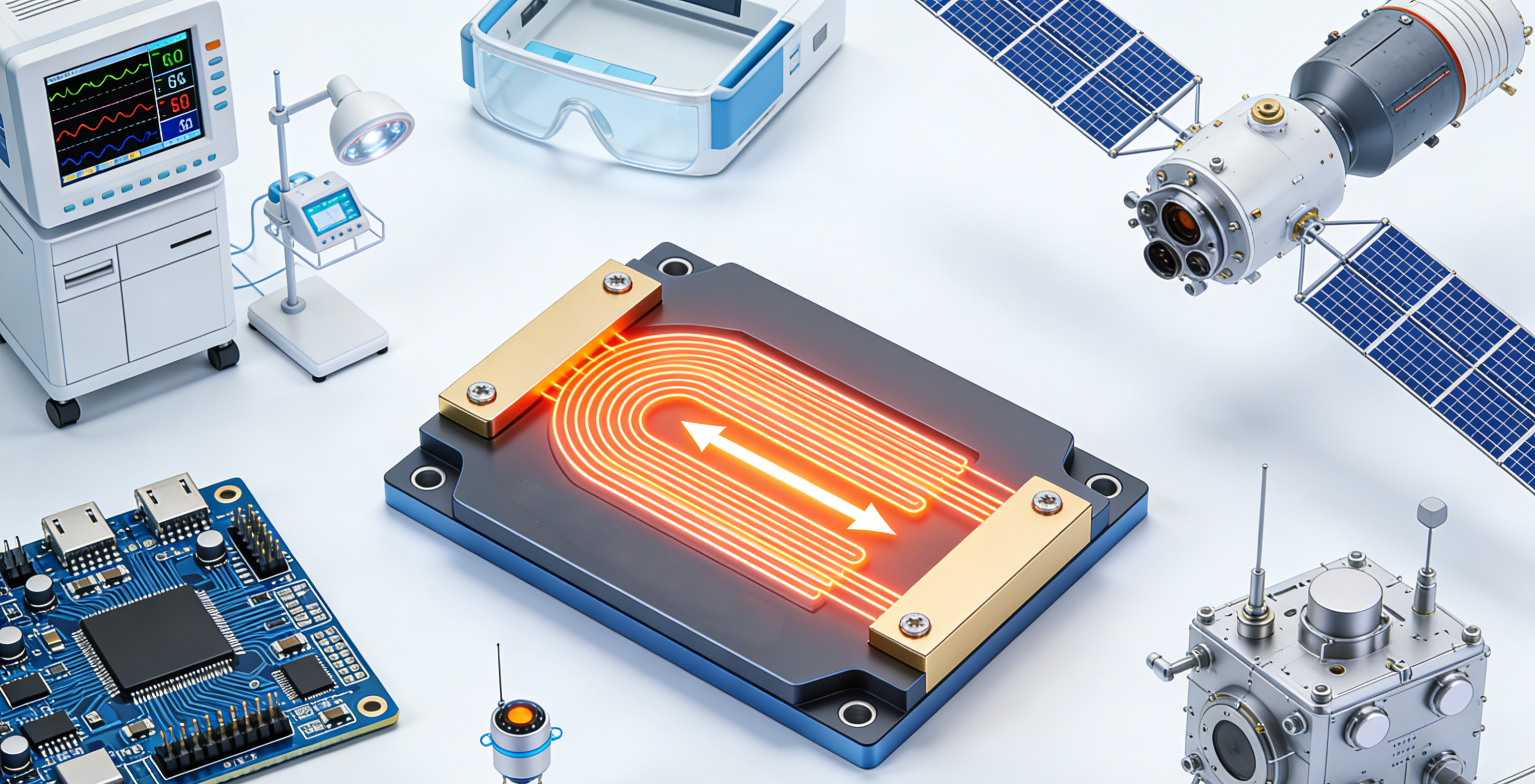
As the core component of solid state heat pumps, thermoelectric coolers (TECs) have revolutionized the technical approach in the field of precision temperature control.
Based on the Peltier Effect, this high precision temperature control solution achieves directional heat transfer via direct current drive, making it an indispensable mechanical motion free refrigeration technology in modern electronic devices, medical instruments, and scientific research equipment. Huajing Thermal Control will deeply analyze its physical principles, material structure, and key technical parameters to provide a theoretical basis for engineering selection.
The Peltier Effect: The Scientific Foundation of Energy Transport
The Peltier Effect describes the heat absorption or release that occurs when an electric current passes through the junction of dissimilar conductors.When direct current flows through a circuit composed of N type and P type semiconductors:
At the junction where current flows from N type to P type: Electrons overcome the potential barrier and absorb heat, forming the cold side (temperature decreases).
At the junction where current flows from P type to N type: Electrons release energy and generate heat, forming the hot side (temperature increases).
The macroscopic performance of this process:The cold side continuously absorbs heat for cooling, while the hot side continuously releases heat, creating a significant temperature difference.Reversing the current direction swaps the cold and hot sides, enabling the same device to operate in both cooling and heating modes.
The quantitative model for heat transfer can be expressed as: Qc = αnp ⋅T1⋅I−0.5I2R−k (T2−T1) Where:
Qc: Cooling capacity of the cold side (W)
αnp: Total Seebeck coefficient of N/P thermocouple legs
I: Operating current (A)
R: Resistance of thermocouple legs (Ω)
k: Total thermal conductivity (W/K)
Material and Structural Design: The Key to Performance Breakthroughs
1. Core Material System
Bismuth Telluride (Bi₂Te₃): The semiconductor material with the highest thermoelectric figure of merit (ZT) at room temperature. Doping produces:
P type Bi₂Te₃: Holes as majority carriers (charge transfer via hole movement)
N type Bi₂Te₃: Free electrons as majority carriers (high electron mobility)
Fabrication Processes: Melting, powder pressing, and hot extrusion ensure consistent thermoelectric properties of the ingots.
Multi Layer Composite Architecture
A typical thermoelectric cooler adopts a sandwich structure:
plaintext
Alumina ceramic substrate (insulation / thermal conduction)
Copper current collector (current distribution)
PN semiconductor thermocouple pairs (Bi₂Te₃ array)
Copper current collector
Ceramic substrate
Electrical Connection: PN semiconductors are connected in series via copper sheets to form thermocouple pairs.
Thermal Path: All thermocouple pairs are thermally parallel to enhance heat transfer efficiency.
Ceramic Substrate Function: Provides mechanical support and electrical insulation, while acting as a high efficiency thermal conduction channel (temperature resistance > 160℃).
Performance Optimization and Technical Challenges
1. Key Performance Indicators
Maximum Temperature Difference (ΔTmax): 60~70℃ for single stage devices; up to 130℃ for multi stage cascaded modules (e.g., TLTTEC1603403020154).
Coefficient of Performance (COP): Ratio of cooling capacity to input electrical power. COP > 2.2 for high quality devices at ΔT = 45℃.
Thermal Inertia: Temperature control response time < 1 second, far exceeding compressor based cooling.
Reliability Bottlenecks and Innovations
Traditional structures suffer from thermal fatigue failure:Differences in thermal expansion coefficients between copper and semiconductor junctions lead to cracking after tens of thousands of thermal cycles. Advanced solutions include:
arc TEC Structure: Elastic thermally conductive resin replaces rigid solder to reduce thermal stress.
SbSn High Melting Point Solder: Replaces BiSn solder (melting point from 138℃ → 235℃), improving fatigue resistance.
Porch Style Lead Design (e.g., RC128 Series): Enhances lead strength for harsh vibration environments.
IV. Selection Guide: Five Key Parameters for Application Matching
TEC performance is highly dependent on system design. Selection must comprehensively consider:
Thermal Load (Qc): Heating power of the object to be cooled (e.g., 15–150 W for CPUs).
Target Temperature Difference (ΔT): Difference between cold side and ambient temperature (e.g., ΔT ≥ 45℃ for a 20℃ cooling requirement).
Space Constraints: Ceramic substrate size must cover the heat source (typical range: 30×30 mm ~ 50×50 mm).
Heat Dissipation Conditions: The hot side must be equipped with a high efficiency heatsink (air / water cooling), otherwise the temperature difference will drop sharply.
Power Supply Capacity: Drive current can exceed 10 A (e.g., PL1057.540 requires 7.6 A / 21.2 V).
As thermoelectric coolers penetrate high end fields such as LiDAR temperature control systems, gene sequencers, and spacecraft thermal management, next generation TECs featuring high COP, wide operating temperature ranges, and ultra long service life (> 200,000 hours) will continue to push the boundaries of precision temperature control technology.
 Contact Our Thermal Experts:
📞 +86 18575222950 (WeChat/WhatApps)
📧 EMAIL: sale02@hj-tc.com
🌐 Browse products: https://www.huajingtc.com (Huajing Cooling Solutions)
Optimize your UAV & Laser & Beauty system's performance with Huajing's advanced thermoelectric cooling technology.


Looking for more
information?

0755 23405284
Email: sale02@hj-tc.com
Add: 3/F No.5 Building,Yesun Pingshan Life and Health Technology Park, No. 19 Linhui Road,Pingshan District, Shenzhen, Guangdong,CN.
©2019- 2024 Huajing Co.,Ltd.Copyright