Release time: August 11, 2026
Views: 123
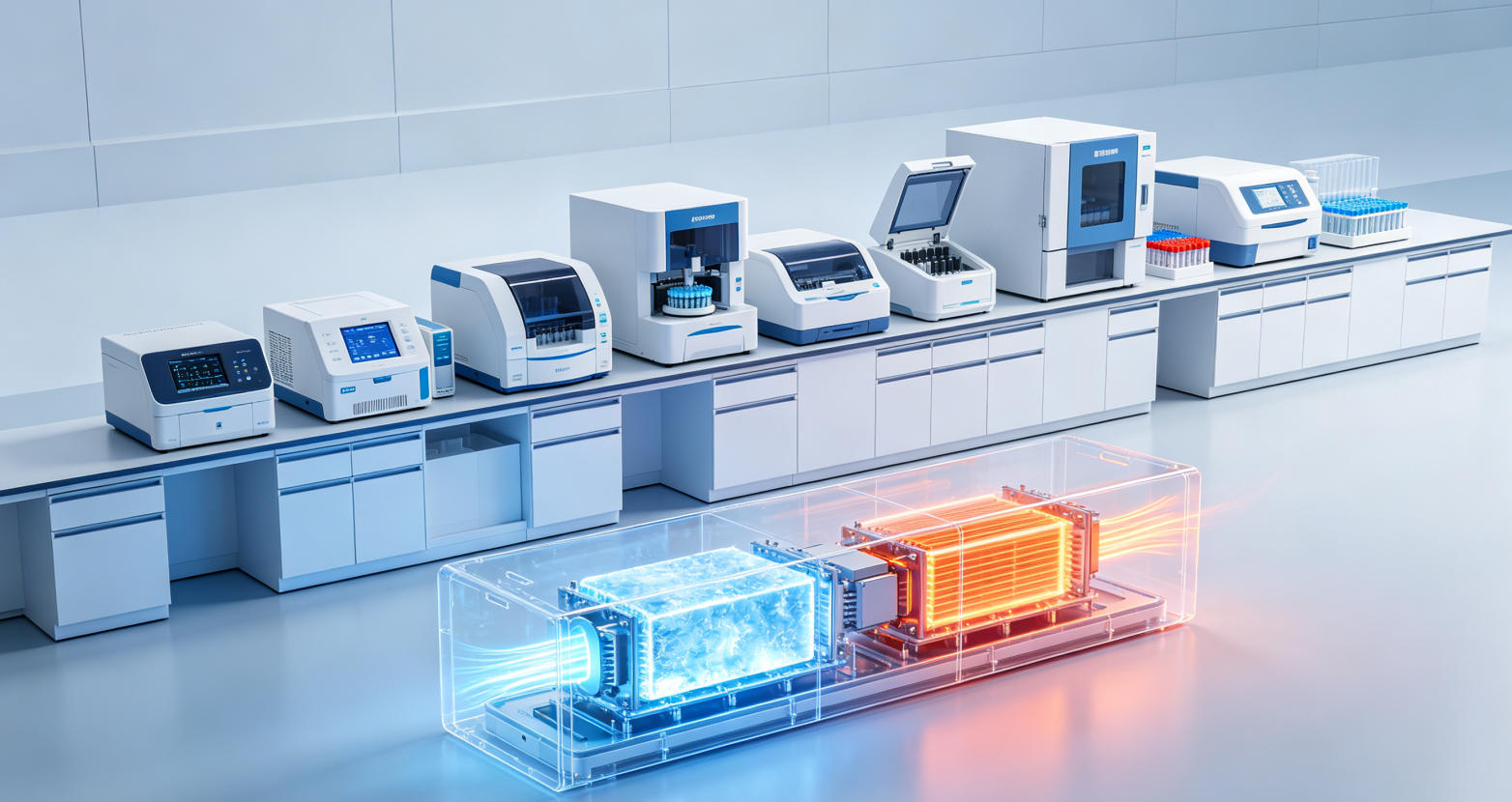
With the rapid advancement of medical engineering and the continuous development of modern medicine, a large number of high-end, precise and sophisticated precision equipment has been widely applied in various clinical departments of hospitals, gradually replacing traditional diagnosis and medical treatment methods. Common equipment in clinical practice such as PCR amplifiers, fully automatic biochemical analyzers, automatic hematology analyzers, incubators and culture cabinets all adopt semiconductor refrigeration technology.
Semiconductor refrigeration technology, also known as thermoelectric refrigeration, realizes refrigeration mainly by virtue of the Peltier effect belonging to thermoelectric effects. As a refrigeration method that features both long-term application history and innovative technical attributes, it has undergone a long development process. From the discovery of the thermoelectric effect in the early 19th century to the first half of the 20th century, the thermoelectric effect was only applied to metal thermocouples for temperature measurement, without any other practical engineering applications.
After the 1950s, the application of semiconductor materials with excellent thermoelectric properties greatly improved the conversion efficiency of the thermoelectric effect. Since then, semiconductor refrigeration technology has been officially put into engineering practice and industrial application.
The semiconductor refrigeration module independently developed and produced by Huajing Temperature Control is a cooling device composed of single or multiple semiconductor refrigeration chips connected in series and parallel. It is an interdisciplinary technology developed since the 1950s, covering the fields of refrigeration technology and semiconductor technology.
The working principle of the module is as follows: when an N-type semiconductor material and a P-type semiconductor material form a thermocouple pair and are connected to a direct current circuit, energy transfer will occur. At the joint where current flows from the N-type semiconductor to the P-type semiconductor, heat is absorbed to form a cold surface; at the joint where current flows from the P-type semiconductor to the N-type semiconductor, heat is released to form a hot surface. The amount of heat absorption and heat release depends on the magnitude of the passing current and the number of N-P semiconductor element pairs.
The commonly used substrate materials for the equipment are ternary solid solution alloys based on bismuth telluride. Among them, the P-type semiconductor materials are Bi₂Te₃ and Sb₂Te₃, and the N-type semiconductor materials are Bi₂Te₃ and Bi₂Se₃.
 Contact Our Thermal Experts:
📞 +86 18575222950 (WeChat/WhatApps)
📧 EMAIL: sale02@hj-tc.com
🌐 Browse products: https://www.huajingtc.com (Huajing Cooling Solutions)
Optimize your UAV & Laser & Beauty system's performance with Huajing's advanced thermoelectric cooling technology.


Looking for more
information?

0755 23405284
Email: sale02@hj-tc.com
Add: 3/F No.5 Building,Yesun Pingshan Life and Health Technology Park, No. 19 Linhui Road,Pingshan District, Shenzhen, Guangdong,CN.
©2019- 2024 Huajing Co.,Ltd.Copyright