Release time: May 28, 2026
Views: 399
As competition in the new energy vehicle (NEV) industry intensifies, vehicle refrigerators, temperature-controlled seats and advanced intelligent driving systems have become mainstream configurations. Behind these comfortable and smart features lies a compact yet critical component: the Thermoelectric Cooler (TEC). Leveraging the Peltier effect, this solid-state chip serves multiple vehicle thermal management scenarios including power batteries, LiDAR for intelligent driving, vehicle cabins and computing chips. It has become a key focus for automakers in thermal management layout. Supported by authoritative industry data, TECs are experiencing robust growth and evolving into one of the pivotal factors shaping competition in the next phase of the NEV sector.
I. What Is a Thermoelectric Cooler? Core Principles & Advantages
A thermoelectric cooler is a solid-state thermal control component operating on the Peltier effect, composed of P-type and N-type semiconductor pellets. When energized, one side of the chip absorbs heat while the other dissipates heat; reversing the electric current switches between cooling and heating modes. Unlike traditional compression refrigeration systems, TECs require no refrigerant, have no moving mechanical parts or pipeline structures, and deliver millisecond-level temperature response.
TECs demonstrate outstanding performance under the harsh operating conditions of automobiles. They achieve a temperature control accuracy of ±0.1°C with ultra-fast response. Their ultra-thin form factor fits perfectly into vehicles' limited installation spaces. The components operate silently with zero vibration, eliminating risks such as liquid leakage and corrosion. These strengths fully align with NEVs' demands for lightweight design, high safety and precise temperature regulation.
II. Four Major Vehicle Application Scenarios for Full-Vehicle Precision Thermal Management
1. Power Batteries: Alleviating Range Anxiety and Reinforcing Safety
Lithium batteries perform optimally at 25°C to 40°C. Excessively high temperatures may trigger thermal runaway and accelerate cell aging, while low temperatures thicken electrolytes and reduce driving range. Traditional air cooling offers limited heat dissipation efficiency, and liquid cooling carries potential risks of leakage and complicated maintenance. TECs enable point-to-point precise temperature control. During fast charging in summer, they rapidly draw away excess heat from battery cells to prevent bulging. In winter, they switch to heating mode to raise battery temperature even at -30°C, effectively mitigating power loss in cold weather. Leading enterprises including Nidec and Toyota have developed TEC-based thermal management solutions for battery systems to extend battery cycle life and stabilize charge-discharge performance.
2. LiDAR: Constant Temperature Protection for Advanced Intelligent Driving
LiDAR is a core perception hardware for high-level autonomous driving and is highly temperature-sensitive. A 10°C rise in ambient temperature can reduce laser output power by approximately 15%, resulting in ranging errors and distorted point cloud data. Mounted closely on core LiDAR components, TECs maintain operating temperature steadily between 25°C and 35°C, restraining wavelength drift and lowering signal noise. Miniature temperature control chips developed by domestic firm Lengxin Technology can create a temperature difference of over 100°C in extreme environments ranging from -40°C to 85°C, ensuring intelligent driving functions remain fully operational under severe weather conditions.
3. Smart Cabin: Key Component for Enhanced Riding Comfort
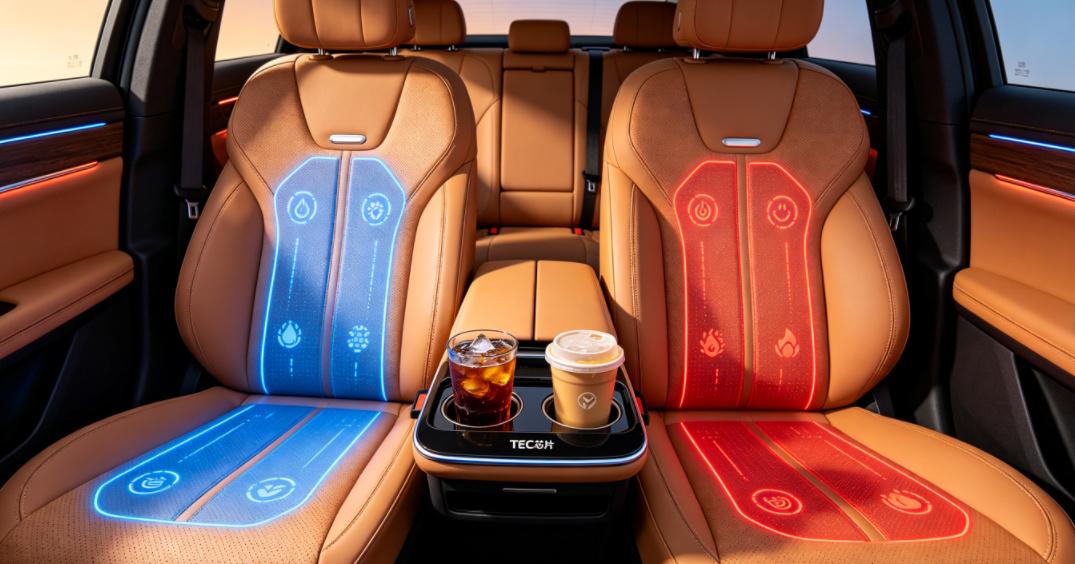
Temperature-adjustable seats, vehicle hot & cold cup holders and on-board refrigerators in high-end NEVs mostly adopt TECs as their core temperature control units. Compared with conventional ventilated seats, TEC climate seats deliver consistent temperature without direct airflow and run quietly. TECs also assist vehicle air conditioners to adjust cabin temperature with faster heating/cooling speed and lower energy consumption. Featuring fluorine-free eco-friendliness, quiet operation and superior comfort, TECs have become a standard fitting in mid-to-high-end NEV cabins.
4. Computing Controllers: Preventing On-board System Lag and Crashes
Mid-to-high-end vehicles are widely equipped with high-performance computing chips exceeding 800 TOPS, which generate massive heat under heavy loads. Conventional heat dissipation methods fail to regulate temperature promptly, easily causing chip frequency reduction, on-board system lag and delayed intelligent driving response. TECs attach directly to heat sources for rapid heat conduction, stabilizing chip operating temperature, sustaining full computing power and ensuring stable operation of intelligent systems.
III. Industry Data Analysis: Promising Growth for Thermal Management Market
Public data released by IMARC Group, Technavio, Huajing Industrial Research Institute, Huimao Technology and other institutions are summarized as follows:
According to IMARC Group, the global semiconductor coolers market reached USD 3.9 billion in 2025.
Statistics from Huajing Industrial Research Institute show that China’s thermoelectric cooler market size stood at approximately CNY 1.346 billion in 2024, while the global market hit around USD 1.022 billion.
Research by Huimao Technology forecasts that the output value of automotive TEC modules will grow from USD 420 million in 2025 to USD 980 million in 2030.
China Commerce Industry Research Institute predicts that the market size of NEV thermal management systems in China will reach CNY 758 billion in 2025.
The solid-state cooling industry maintains a compound annual growth rate of around 8.1%. The Asia-Pacific region accounts for 43.7% of global growth in the solid-state cooling market, with China acting as the primary driving force.
III. Accelerated Layout by Automakers: TEC on Track to Become Industry Standard
With the popularization of 800V high-voltage fast charging and high-level intelligent driving, TECs have evolved from an optional accessory into an indispensable component for full-vehicle thermal management. Major automakers are actively filing relevant patents and building integrated vehicle thermal management systems.
In March 2026, Li Auto obtained a patent titled Heat Exchange Device, Thermal Management System, Vehicle Refrigerator and Automobile (Publication No.: CN224018575U), which involves the application of thermoelectric coolers. BYD filed a patent named Thermal Management System and Automobile (Publication No.: CN121734025A), covering cold storage heat exchangers and multi-loop switching designs, exploring the collaborative thermal control of TECs and vehicle air conditioners. Additionally, upgraded safety standards for the energy storage industry require constant temperature protection for energy storage components, further expanding TEC application scenarios. Industry projections indicate that the penetration rate of TECs in NEVs will rise from the current 20% to over 65% within the next 3 to 5 years, and the technology will gradually be adopted in family commuter vehicles.
Boasting safe, precise and efficient temperature control performance, thermoelectric coolers (TECs) are applied across four core NEV segments: batteries, intelligent driving, smart cabins and computing systems. They not only improve riding experience and driving safety, but also represent a major direction for automakers to upgrade thermal management technologies. Driven by technological advancements from domestic automakers and material enterprises, the TEC industry has entered a high-growth era, and the trillion-yuan thermal management track is ushering in new opportunities. This unassuming chip is emerging as one of the key components that determine the competitiveness of new energy vehicles in the next stage of development.
As a national high-tech and specialized & sophisticated enterprise focusing on thermoelectric cooling technology, Huajing Temperature Control has dedicated years to TEC R&D and production, holding a number of thermal management patents. We strictly comply with the automotive quality standard IATF 16949.
Our product lineup features customized thermoelectric coolers tailored for NEV batteries, LiDAR and smart cabins. We deliver customized thermal management solutions with high stability, large temperature difference and excellent high/low temperature resistance, catering to mass production, R&D and testing demands of automakers. We provide reliable hardware support for full-range vehicle thermal management.
 Contact Our Thermal Experts:
📞 +86 18575222950 (WeChat/WhatApps)
📧 EMAIL: sale02@hj-tc.com
🌐 Browse products: https://www.huajingtc.com (Huajing Cooling Solutions)
Optimize your UAV & Laser & Beauty system's performance with Huajing's advanced thermoelectric cooling technology.


Looking for more
information?

0755 23405284
Email: sale02@hj-tc.com
Add: 3/F No.5 Building,Yesun Pingshan Life and Health Technology Park, No. 19 Linhui Road,Pingshan District, Shenzhen, Guangdong,CN.
©2019- 2024 Huajing Co.,Ltd.Copyright