Release time: May 29, 2026
Views: 273
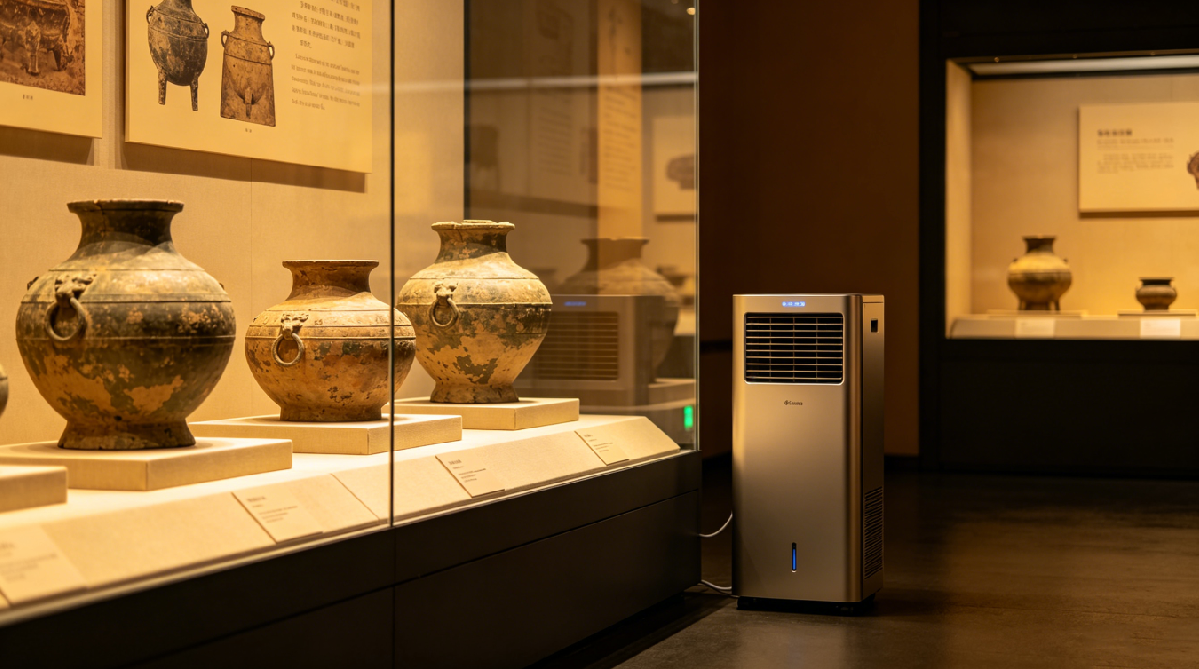
As important carriers of culture and art, museums preserve a wealth of cultural relics and artworks, and bear witness to historical memories and the crystallization of human wisdom. However, humidity, as one of the core factors affecting the preservation quality of cultural relics, has always been a key focus and a major challenge in museum management.
Traditional dehumidifiers, as common moisture removal equipment, play an essential role in museum moisture-proof work. This paper focuses on introducing an innovative humidity control solution — the electrolytic dehumidifier. By comparing the practical effects of electrolytic dehumidifiers and traditional dehumidifiers in museum scenarios, it intuitively demonstrates the unique advantages of electrolytic dehumidifiers.
Applications and Deficiencies of Traditional Dehumidifiers in Museums
Traditional dehumidifiers reduce air humidity through circulating refrigeration and are widely used dehumidification devices. Featuring low prices, compact size and desirable dehumidification performance, they are highly suitable for dehumidification in small rooms or for temporary use. Nevertheless, they reveal prominent deficiencies in museums that impose extremely strict requirements on humidity control.
1. Defective Humidification and Humidity Control
Traditional dehumidifiers generally rely on manual water filling to achieve humidification. The equipment converts liquid water into fine mist or steam and releases it into the air to raise ambient humidity. Such repetitive manual operations consume substantial human resources and time costs.
2. Persistent Operating Noise
Traditional dehumidifiers produce a continuous humming sound during operation, which disturbs the quiet environment essential for museums. Long-term noise not only undermines visitors’ viewing experience, but also exerts adverse impacts on the preservation environment of cultural relics.
3. High Energy Consumption
Traditional dehumidifiers require refrigeration or heating to operate, leading to high energy consumption. This not only increases the daily operating costs of museums, but also runs counter to the modern concepts of energy conservation and environmental protection.
4. Limitation by Ambient Temperature
Traditional dehumidifiers fail to operate normally at temperatures below 0°C, which poses a major restriction for museums in cold regions. Especially in winter, when the ambient temperature drops, such dehumidifiers stop working and cannot maintain stable humidity for the preservation of cultural relics.
5. High Maintenance Costs
With complex mechanical structures and multiple vulnerable parts, traditional dehumidifiers require regular maintenance and component replacement, which increase maintenance costs and operational workload.
Advantages of Huajing Temperature-Controlled Electrolytic Dehumidifiers in Museum Applications
As a new type of dehumidification equipment, electrolytic dehumidifiers adopt electrolysis-based dehumidification technology, which overcomes most shortcomings of traditional dehumidifiers and delivers remarkable performance in museum applications.
1. Silent Operation
Electrolytic dehumidifiers produce almost no noise during operation, as they are free of mechanical moving parts such as fans and compressors. This makes them perfectly suited for quiet museum environments. They will not disturb visitors’ experience or negatively affect the preservation conditions of cultural relics.
2. High Efficiency and Energy Saving
These dehumidifiers act directly on water molecules in the air without energy-intensive refrigeration or heating processes, resulting in far lower energy consumption than traditional models. This advantage effectively reduces museums’ operating costs and complies with modern energy-saving and eco-friendly concepts.
3. No Restriction by Ambient Temperature
Electrolytic dehumidifiers can operate stably at temperatures below 0°C without being affected by ambient temperature. They serve as an ideal solution for museums in cold regions, ensuring reliable humidity control for cultural relic preservation even in winter.
4. Simple Structure and Convenient Maintenance
Featuring a simplified structural design with no complex mechanical components or vulnerable parts, electrolytic dehumidifiers require minimal maintenance. This not only cuts down maintenance costs, but also improves the reliability and service life of the equipment.
5. Versatile Functional Applications
In addition to dehumidification, electrolytic dehumidifiers can function as humidifiers by adjusting their installation orientation. Multiple devices can work collaboratively to achieve optimal humidity control. This multi-functional design meets the diverse needs of museums in different seasons and scenarios, providing a more flexible environmental control solution for cultural relic preservation.
Practical Application Cases of Electrolytic Dehumidifiers in Museums
To fully illustrate the superior performance of electrolytic dehumidifiers in museum scenarios, several practical application cases are presented as follows.
1. The Palace Museum
As one of the most crucial museums in China, the Palace Museum houses a large collection of precious cultural relics and artworks. To guarantee the preservation quality of these treasures, the museum adopts electrolytic dehumidifiers for professional humidity control. The devices’ silent operation and high energy efficiency create a stable and quiet preservation environment for cultural relics.
2. The British Museum
As one of the world’s most renowned museums, the British Museum boasts abundant collections of cultural relics and artworks. To eliminate the adverse impacts of humidity on cultural relic preservation, it applies electrolytic dehumidifiers for humidity management. Thanks to their stable performance and temperature adaptability, the museum can maintain a constant and ideal humidity environment for its collections under all climatic conditions.
3. The Metropolitan Museum of Art
As one of the largest art museums in the United States, the Metropolitan Museum of Art holds numerous artworks and cultural relics. Electrolytic dehumidifiers are deployed here to ensure the scientific preservation of its collections. The versatile functions and wide adaptability of these dehumidifiers enable the museum to maintain suitable humidity conditions in different seasons and scenarios, providing strong protection for art collections.
Electrolytic dehumidifiers have demonstrated outstanding advantages in museum applications. They not only solve the drawbacks of traditional dehumidifiers in terms of noise generation, energy consumption and temperature adaptability, but also provide a more flexible and reliable environmental control solution. In the future, electrolytic dehumidifiers will play an increasingly vital role in the museum industry and contribute more to the cause of cultural relic protection.
 Contact Our Thermal Experts:
📞 +86 18575222950 (WeChat/WhatApps)
📧 EMAIL: sale02@hj-tc.com
🌐 Browse products: https://www.huajingtc.com (Huajing Cooling Solutions)
Optimize your UAV & Laser & Beauty system's performance with Huajing's advanced thermoelectric cooling technology.


Looking for more
information?

0755 23405284
Email: sale02@hj-tc.com
Add: 3/F No.5 Building,Yesun Pingshan Life and Health Technology Park, No. 19 Linhui Road,Pingshan District, Shenzhen, Guangdong,CN.
©2019- 2024 Huajing Co.,Ltd.Copyright