Release time: August 20, 2026
Views: 124
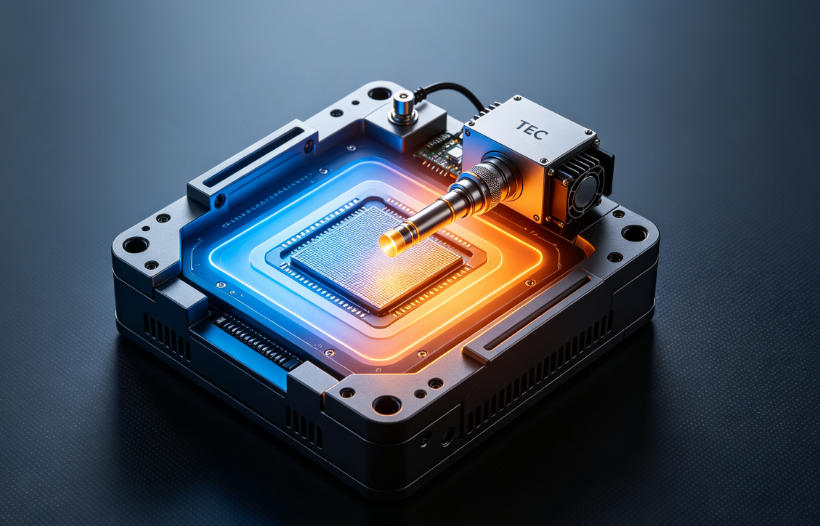
Thermal management design runs through the entire R&D process of semiconductor lasers, chip testing equipment, and medical optoelectronic instruments. Many equipment prototypes deliver qualified performance but suffer from poor consistency and high failure rates after mass production. Root cause analysis reveals that such issues typically stem from overly conservative selection of heat dissipation and temperature control schemes in the early design stage. Based on extensive engineering implementation experience, this article sorts out the applicable boundaries of mainstream thermal management solutions for precision semiconductor and optoelectronic equipment, as well as common design misunderstandings.
I. Comparison of Mainstream Temperature Control Solutions
Air Cooling (Passive / Forced Convection)
Applicable to scenarios with loose temperature difference requirements and no high-precision constant temperature demands. Disadvantages include large temperature control fluctuations, airflow disturbance to optical platforms, and heat dissipation-only functionality with no refrigeration capability.
External Industrial Chiller
Designed for equipment with ultra-high thermal load. Its drawbacks are bulky size, complex pipeline layout and inherent vibration, making it difficult to integrate into compact complete machines.
TEC Thermoelectric Cooling System (Recommended for Precision Equipment)
Advantages: Bidirectional cooling and heating control, high temperature control accuracy, compact structure, and support for embedded integration.
Limitations: The maximum cooling capacity of a single module is fixed, and the coefficient of performance (COP) declines under large temperature difference working conditions. Optimal heat-side heat dissipation design is mandatory.
Applicable scenarios: Laser diode temperature control, small constant-temperature stages, infrared detectors, and portable medical laser equipment.
Frequent Design Pitfalls of TEC Temperature Control Systems
Selecting models based solely on average power consumption while ignoring peak instantaneous thermal load
Equipment start-stop and pulse operating states generate instantaneous thermal shocks. Reserving a 20%–35% cooling margin is the foundation of stable mass production.
Neglecting heat-side heat dissipation capacity
The performance ceiling of a TEC is determined by its heat-side heat dissipation capability. In numerous projects, adequately specified TECs fail to achieve the expected low temperature and precision due to matching with simple aluminum heat sinks. Water-cooled cold plates are the preferred solution for medium and high-power scenarios.
Lack of anti-condensation supporting design
Condensation occurs when the temperature of the TEC cold side drops below the dew point. For closed cavity scenarios, active dehumidification components are recommended to form a joint temperature and humidity protection system.
Ignoring vibration and mounting stress
Thermoelectric ceramic substrates feature high brittleness. Uneven assembly pressure and severe vibration will accelerate cracking and failure of internal thermoelectric arms.
Integrated Solution Trend: Collaborative Design of Temperature Control and Dehumidification
An increasing number of high-end equipment manufacturers adopt combined solutions: TECs achieve precise constant temperature of core components, while SPE electrolytic dehumidification elements regulate the humidity of closed cavities. This integrated structure simultaneously resolves temperature drift and condensation corrosion issues, significantly improving the Mean Time Between Failures (MTBF) of equipment.
Thermal management is not a post-production remedial process but needs to be incorporated in the initial hardware scheme design stage. Huajing Temperature Control provides a full range of thermal management products, including standardized and customized TEC thermoelectric modules, water-cooled cold plate assemblies, and SPE electrolytic dehumidification components. We offer professional technical support covering thermal load calculation, scheme simulation, sample prototyping and structural adaptation for early-stage project development. We serve global OEM manufacturers in the laser, semiconductor testing and medical optoelectronic industries. If you are evaluating thermal solutions for new projects, you can submit equipment operating parameters to obtain a free customized solution proposal.
 Contact Our Thermal Experts:
📞 +86 18575222950 (WeChat/WhatApps)
📧 EMAIL: sale02@hj-tc.com
🌐 Browse products: https://www.huajingtc.com (Huajing Cooling Solutions)
Optimize your UAV & Laser & Beauty system's performance with Huajing's advanced thermoelectric cooling technology.


Looking for more
information?

0755 23405284
Email: sale02@hj-tc.com
Add: 3/F No.5 Building,Yesun Pingshan Life and Health Technology Park, No. 19 Linhui Road,Pingshan District, Shenzhen, Guangdong,CN.
©2019- 2024 Huajing Co.,Ltd.Copyright