Release time: August 17, 2026
Views: 146
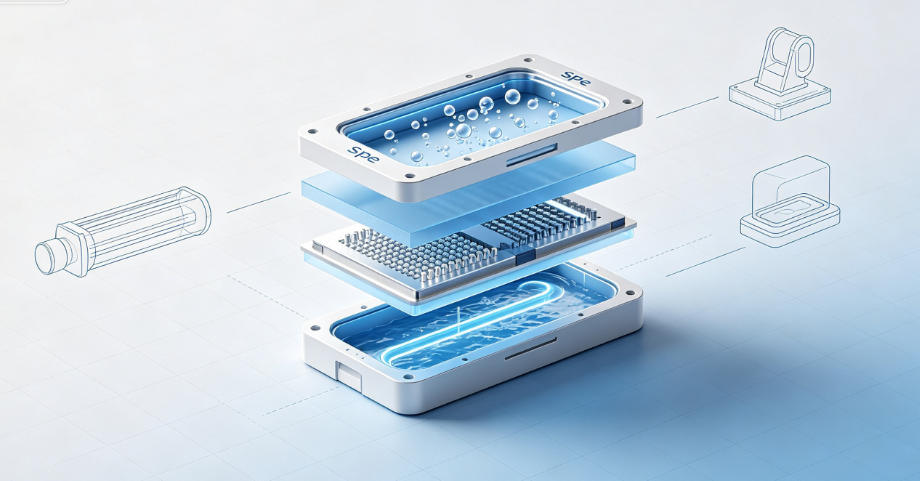
Most precision semiconductor equipment, laser resonant cavities, and optical detection cavities adopt sealed structures to isolate dust and stabilize the optical path environment. However, during long-term operation, water vapor tends to remain inside the cavities and form condensation, triggering three major risks: fogging and mildew growth on optical lenses, short circuits caused by reduced insulation performance of circuit boards, and electrochemical corrosion of metal structural components.
Common industrial moisture-proof solutions have obvious shortcomings:
Desiccant adsorption dehumidification: Limited adsorption capacity, requiring regular replacement and incapable of long-term unattended operation;
Heating dehumidification: Only raises the internal temperature without removing water molecules, leaving potential humidity hazards unresolved;
Condensing semiconductor dehumidification: Risks condensed water leakage and generates vibration, making it unsuitable for high-precision optical platforms.
The SPE solid polymer electrolytic dehumidification element offers an innovative technical solution. Driven by low-voltage DC power of 3V, it continuously electrolyzes water molecules inside sealed cavities through electrochemical reactions. Hydrogen ions selectively pass through the solid electrolyte membrane and recombine into water vapor outside the cavity for discharge, realizing sustainable outward water vapor removal.
Core advantages of this solution:
✅ No mechanical components, zero vibration and silent operation: No interference with optical measurement and laser optical paths;
✅ No condensed water generation: Completely eliminates the risk of water leakage;
✅ Low power consumption and long service life: Supports 4–6 years of continuous operation with zero maintenance;
✅ Compact size: Can be directly embedded in narrow and confined sealed cavities;
✅ Wide operating temperature range: Covers the conventional working temperature range of most semiconductor instruments.
Typical Application Scenarios
- Moisture and fog prevention for sealed optical cavities and resonant cavities of laser equipment;
- Sealed optical path boxes of semiconductor detection instruments and spectral analyzers;
- Small pre-sealed vacuum cavities and sensor protective housings;
- Humidity control for sealed internal modules of medical optoelectronic equipment.
Numerous projects equipped with TEC temperature control systems have verified that condensation is more likely to form in precision low-temperature temperature-controlled environments. The combined solution of precise temperature control + active humidity management eliminates two major equipment failure causes—temperature drift and moisture, and significantly reduces the overall equipment repair rate.
Conclusion
Collaborative temperature and humidity management represents the next-generation design trend for micro-environments of high-end precision equipment. Huajing Temperature Control provides both TEC precision temperature control modules and SPE electrolytic dehumidification components, delivering integrated temperature and dehumidification micro-environment solutions for manufacturers of laser, semiconductor testing and medical optoelectronic equipment. We support customized dehumidification specifications based on cavity volume and synchronous development with overall equipment structures. Feel free to contact our technical team for professional cavity moisture-proof solution evaluation and service life test data.
 Contact Our Thermal Experts:
📞 +86 18575222950 (WeChat/WhatApps)
📧 EMAIL: sale02@hj-tc.com
🌐 Browse products: https://www.huajingtc.com (Huajing Cooling Solutions)
Optimize your UAV & Laser & Beauty system's performance with Huajing's advanced thermoelectric cooling technology.


Looking for more
information?

0755 23405284
Email: sale02@hj-tc.com
Add: 3/F No.5 Building,Yesun Pingshan Life and Health Technology Park, No. 19 Linhui Road,Pingshan District, Shenzhen, Guangdong,CN.
©2019- 2024 Huajing Co.,Ltd.Copyright