Release time: July 28, 2026
Views: 210
I. Working Principle and Structural Advantages of Ring Thermoelectric Coolers
All semiconductor refrigeration devices transfer heat based on the Peltier effect. Featuring no compressors, no refrigerants, and no vibration, they achieve directional heat transfer through P and N-type bismuth telluride thermocouple pairs. When energized, one side absorbs heat for refrigeration while the other dissipates heat; reversing the current switches the heating and cooling modes, with a temperature control accuracy of ±0.01℃.
Conventional square TECs adopt an integral ceramic substrate without reserved optical channels. In contrast, ring TECs feature exclusive structural optimizations tailored for optical medical aesthetic equipment, with the following core advantages:
1. Central hollow through-hole: The aperture is customizable from 2mm to 60mm, with a standard 10mm aperture universally applied in 808 hair removal devices, allowing vertical and unobstructed laser penetration.
2. Evenly arranged circumferential thermocouples: Thermoelectric particles are uniformly distributed along the ring, eliminating the thermal stress accumulation at the four corners of square TECs.
3. Thickened insulated ceramic substrate: The inner wall of the circular hole is edge-reinforced to prevent cracking during cold and hot cycles, complying with the high-voltage insulation standards for handheld medical aesthetic equipment.
4. Compact dimensions: Standard models with an outer diameter of 30–40mm and a thickness of approximately 3.2mm can be directly installed in the handpieces of 808 hair removal devices.
II. Comparative Test of Ring TECs vs. Square TECs
Test conditions: Room temperature of 25℃, rated power of approximately 50W, continuous 8-hour operation, with infrared thermal imaging temperature measurement and cold-hot cycle aging tests conducted.
Comparison Dimension | Ring TEC | Slotted Square TEC | Practical Impact on 808 Hair Removal Devices |
Maximum temperature difference across the cold surface | ≤0.5℃ | 2~3℃ | Unbalanced cooling and heating at the treatment head of square TEC-equipped devices, causing burning sensations on the lip and periocular areas |
Laser energy loss | Minimal loss via straight hollow penetration | Substantial loss due to side slot avoidance design | Reduced hair removal efficacy and significantly increased scalding risks under the same power output |
Long-term cyclic cooling attenuation | Excellent fatigue resistance with stable performance | Fragile structure with obvious performance attenuation | Cooling efficiency of low-end devices declines after six months of use |
Interfacial fitting thermal resistance | Perfectly matches circular sapphire windows with minimal gaps | Large gaps exist when square substrates fit circular windows | Elevated minimum cooling temperature, failing to stably maintain the safe cooling range for medical aesthetic treatments |
Medical aesthetic industry specifications require the epidermal cooling temperature to be stably maintained within 5–10℃. Excessive local temperature difference may cause epidermal damage. Modified square refrigeration chips are inherently unable to meet the safety standards of high-energy hair removal equipment. In comparison, ring TECs wrap the sapphire window in a 360° uniform cooling zone, steadily maintaining a safe cooling temperature of 6–8℃ throughout the treatment, balancing therapeutic efficacy and customer comfort.
III. Main Application Scenarios of Ring TECs
1. Medical Aesthetic Laser Equipment
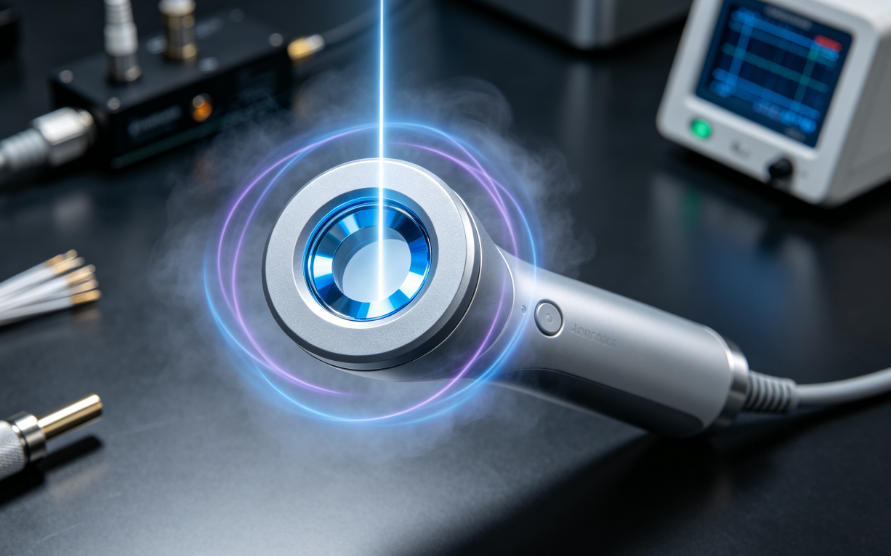
808 semiconductor ice-point hair removal devices represent a core application scenario for ring TECs. The 808nm laser acts on hair follicle melanin through selective photothermolysis, requiring synchronous low-temperature epidermal protection. The central through-hole of the ring TEC allows laser emission, while the annular cold surface closely fits the sapphire window, enabling safe operation for all treatment areas. Additionally, ring temperature control structures are also applicable to picosecond freckle removal, photon skin rejuvenation and other optical cosmetic devices.
2. Optoelectronics and Industrial Lasers
Ring TECs are used for stable temperature control in butterfly pump sources, infrared detection lenses, lidar probes and other components, suppressing laser wavelength drift and ensuring equipment precision.
3. Laboratory Precision Optical Instruments
Infrared thermal imaging devices and spectral analyzers adopt symmetric ring temperature control to eliminate temperature field interference and improve the accuracy of detection data.
IV. Selection Guidelines for Ring TECs for Commercial 808 Hair Removal Devices
For mainstream commercial 808 laser devices with power ranging from 600W to 1200W, the following parameters are recommended for product selection:
1. Basic dimensions: Outer diameter of 30–40mm, central through-hole of approximately 10mm, thickness of about 3.2mm, rated power of 45–55W, and maximum temperature difference of 60–70℃ between hot and cold ends.
2. Material and craftsmanship: High-purity bismuth telluride chips with a thermoelectric figure of merit (ZT) ≥0.8; alumina ceramic substrates with integrated annular pressure welding and no segmented splicing.
3. Factory inspection: Inspection reports covering high-voltage insulation, 8-hour continuous aging, full-area temperature uniformity, and cold-hot cycle tests are recommended.
4. Supporting heat dissipation: 808 handpieces shall be equipped with a micro water-cooling module, with high-thermal-conductivity grease filled at the interface to control interfacial thermal resistance within a reasonable range.
V. Procurement Suggestions for Domestic Ring TECs
Featuring a hollow symmetric structure, ring TECs fundamentally solve the structural defects of square TECs, including optical path loss, uneven temperature distribution and service life attenuation, making them the preferred temperature control solution for 808 ice-point hair removal devices and other optical medical aesthetic equipment. Measured data verifies that ring TECs can control the full-area temperature difference within 0.5℃ and maintain stable cooling performance during long-term continuous operation, helping reduce store customer complaints and improve hair removal treatment efficacy.
Domestic manufacturers represented by Huajing Temperature Control deliver products with performance comparable to imported alternatives. They offer cost advantages for standard-specification products, fast delivery of standard stock items, and short customization sample delivery cycles for 808 dedicated devices. Meanwhile, comprehensive supporting solutions including thermal simulation, water-cooling modules and drive boards are available.
Note: Partial specific data in this article (including precise optical energy loss percentage, cooling attenuation percentage, and market share of each application scenario) are sourced from industry technical documents and public manufacturer promotional data for reference only. The comparative data in the article are laboratory test results under specific conditions, and the actual performance may vary according to different working conditions.
 Contact Our Thermal Experts:
📞 +86 18575222950 (WeChat/WhatApps)
📧 EMAIL: sale02@hj-tc.com
🌐 Browse products: https://www.huajingtc.com (Huajing Cooling Solutions)
Optimize your UAV & Laser & Beauty system's performance with Huajing's advanced thermoelectric cooling technology.


Looking for more
information?

0755 23405284
Email: sale02@hj-tc.com
Add: 3/F No.5 Building,Yesun Pingshan Life and Health Technology Park, No. 19 Linhui Road,Pingshan District, Shenzhen, Guangdong,CN.
©2019- 2024 Huajing Co.,Ltd.Copyright