Release time: August 04, 2026
Views: 296
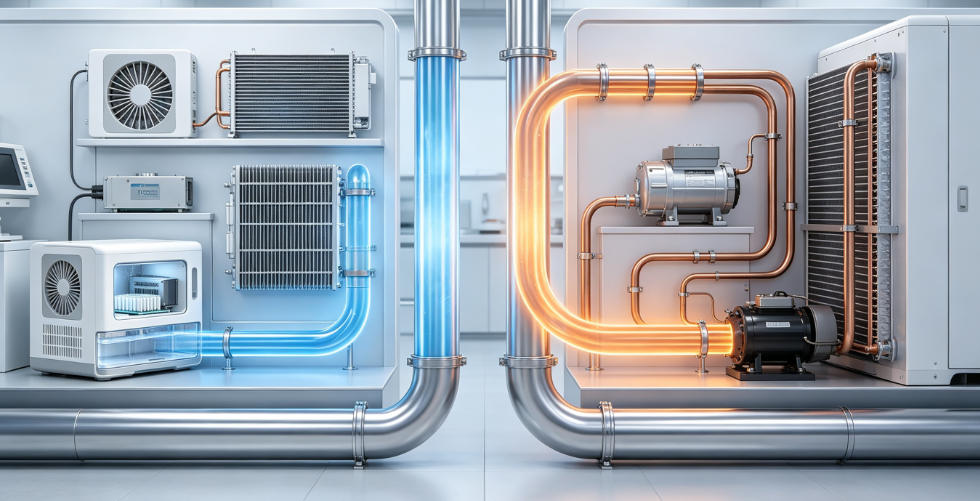
As a core support for modern industry and daily life, refrigeration technology directly determines the efficiency, cost and sustainability of thermal management systems. Semiconductor refrigeration (thermoelectric refrigeration) and compressor refrigeration (vapor compression refrigeration) are two mainstream technical solutions with significant differences in working principles, application scenarios and market positioning.
Based on thermodynamic theories, engineering practices and industry data, Huajing Temperature Control systematically compares the core characteristics of the two technologies in this article, aiming to provide objective and reliable references for technical selection.
I. Comparison of Technical Principles and System Configurations
1. Semiconductor Refrigeration Technology
Working Principle: Based on the Peltier effect, directional heat transfer is realized by driving carrier migration at the interface of P-type and N-type semiconductor materials with direct current.
System Composition: Consists of thermoelectric coolers (TECs), heat sinks, power supplies and control systems, with no mechanical moving parts.
Key Parameters: Refrigeration efficiency is determined by the thermoelectric figure of merit (ZT value). The ZT value of commercial bismuth telluride (Bi₂Te₃) materials currently ranges from 1.0 to 1.2.
2. Compressor Refrigeration Technology
Working Principle: Relying on the vapor compression cycle, heat transfer is achieved by driving the cyclic phase change of refrigerant between the evaporator (heat absorption) and the condenser (heat release).
System Composition: Features four core components including a compressor, expansion valve, evaporator and condenser, and operates based on mechanical transmission and fluid dynamics design.
Key Parameters: Its coefficient of performance (COP) generally ranges from 2.0 to 4.0, which is greatly affected by refrigerant types and operating conditions.
II. Comparative Analysis of Performance Parameters
1. Energy Efficiency
Compressor Refrigeration: Under standard operating conditions (ambient temperature of 25℃ and target temperature of -20℃), its COP can exceed 3.0, making it suitable for scenarios with large temperature differences and high cooling loads.
Semiconductor Refrigeration: Its COP usually ranges from 0.3 to 1.2. It maintains high efficiency when the temperature difference (ΔT) is no more than 30℃, while the efficiency drops exponentially with the increase of temperature difference.
Conclusion: Compressor refrigeration boasts prominent energy efficiency advantages for large-scale cooling demands, while semiconductor refrigeration is more applicable to scenarios with small temperature differences and intermittent operation.
2. Temperature Control Accuracy
Semiconductor Refrigeration: It achieves precise temperature control within ±0.1℃ by adjusting current, with a response time of less than 1 second and supports dual-way temperature regulation (switchable between cooling and heating).
Compressor Refrigeration: Restricted by mechanical inertia, its temperature control accuracy is usually ±1℃ with a response time of 3 to 5 minutes, and it cannot switch between cooling and heating modes directly.
Conclusion: Semiconductor refrigeration is the preferred choice for precision instruments, medical equipment and other high-precision scenarios.
3. Environmental Adaptability
Semiconductor Refrigeration: It involves no risk of refrigerant leakage, operates stably in extreme environments such as vacuum and high-altitude conditions, and delivers excellent vibration resistance (adopted by NASA in space stations).
Compressor Refrigeration: It relies on refrigerant phase change, resulting in a significant efficiency decline in low-temperature environments (COP decreases by 40% at -30℃), accompanied by potential refrigerant leakage risks.
Conclusion: Semiconductor solutions are prioritized for extreme environments including aerospace and deep-sea equipment applications.
III. Environmental Protection and Sustainability Evaluation
1. Environmental Impact of Refrigerants
Compressor Refrigeration: Traditional refrigerants (e.g., R22, R410A) have an extremely high global warming potential (GWP) of up to 2088 and are strictly regulated by the Montreal Protocol. New low-GWP refrigerants (e.g., R32, CO₂) still pose risks of flammability or high-pressure operation.
Semiconductor Refrigeration: It requires no refrigerants and produces no direct greenhouse gas emissions, fully complying with the EU F-Gas Regulation.
2. Carbon Footprint of Energy Consumption
Compressor Refrigeration: Its high energy efficiency reduces power consumption per unit of cooling capacity, yet indirect carbon emissions remain high when powered by coal-fired electricity.
Semiconductor Refrigeration: Its low energy efficiency increases power consumption per unit of cooling capacity, and carbon neutrality can only be achieved when combined with clean energy such as photovoltaic power supply.
IV. Application Scenario Adaptability
1. Advantageous Application Fields of Semiconductor Refrigeration
Miniaturized Equipment: Portable car refrigerators (volume < 50L), CPU heat sinks, laser equipment temperature control systems.
High-precision Scenarios: PCR instruments (±0.1℃ temperature control), infrared detector cooling systems.
Special Environments: Space station equipment, underground instrument cabinets.
2. Advantageous Application Fields of Compressor Refrigeration
Large-scale Cooling: Household refrigerators (> 200L), commercial cold storage, central air conditioning systems.
Large Temperature Difference Demands: Quick-freezing equipment (target temperature < -40℃), industrial cold dryers.
Continuous Operation Scenarios: Cold chain logistics, data center cooling systems.
V. Prospect of Technical Development Trends
1. Development Direction of Semiconductor Refrigeration
Material Innovation: Topological insulators and nanocomposite thermoelectric materials (with ZT value exceeding 2.0) can boost the COP to over 1.5.
System Integration: Integration with phase change materials (PCMs) and heat pipe technologies alleviates efficiency attenuation of thermoelectric modules under high-load operation.
2. Development Direction of Compressor Refrigeration
Refrigerant Replacement: Green technologies such as CO₂ transcritical cycle and magnetic refrigeration are gradually commercialized.
Intelligent Control: Combination of variable-frequency compressors and AI algorithms realizes dynamic energy efficiency optimization.
Semiconductor refrigeration and compressor refrigeration are not simply superior or alternative technologies, but complementary technical routes. Semiconductor refrigeration is preferred for scenarios requiring miniaturization, high precision and extreme environmental adaptability. Compressor refrigeration is more competitive for applications with large cooling capacity, high energy efficiency or ultra-low temperature requirements.
Huajing Co., Ltd. is a national high-tech enterprise integrating the R&D, production, sales and service of temperature control system solutions. The company focuses on three core businesses: semiconductor refrigeration technology, vapor compression refrigeration technology, and flexible thermal conductive electrothermal film application technology.
It provides one-stop integrated technical solutions covering 3D structural design, CAE thermal simulation analysis, and supporting electronic hardware and software development. Its products are widely applied in multiple industries including medical equipment, beauty devices, laser equipment, communication and power systems, aerospace, and new energy vehicles.
Huajing Temperature Control holds a number of technical patents and has obtained ISO9001 and IATF 16949 quality management system certifications.
The company is committed to providing customers with high-performance, high-stability and high-reliability thermal management solutions and products. With breakthroughs in material science and system design, semiconductor refrigeration and compressor refrigeration will achieve refined collaborative application models in more fields in the future.
 Contact Our Thermal Experts:
📞 +86 18575222950 (WeChat/WhatApps)
📧 EMAIL: sale02@hj-tc.com
🌐 Browse products: https://www.huajingtc.com (Huajing Cooling Solutions)
Optimize your UAV & Laser & Beauty system's performance with Huajing's advanced thermoelectric cooling technology.


Looking for more
information?

0755 23405284
Email: sale02@hj-tc.com
Add: 3/F No.5 Building,Yesun Pingshan Life and Health Technology Park, No. 19 Linhui Road,Pingshan District, Shenzhen, Guangdong,CN.
©2019- 2024 Huajing Co.,Ltd.Copyright